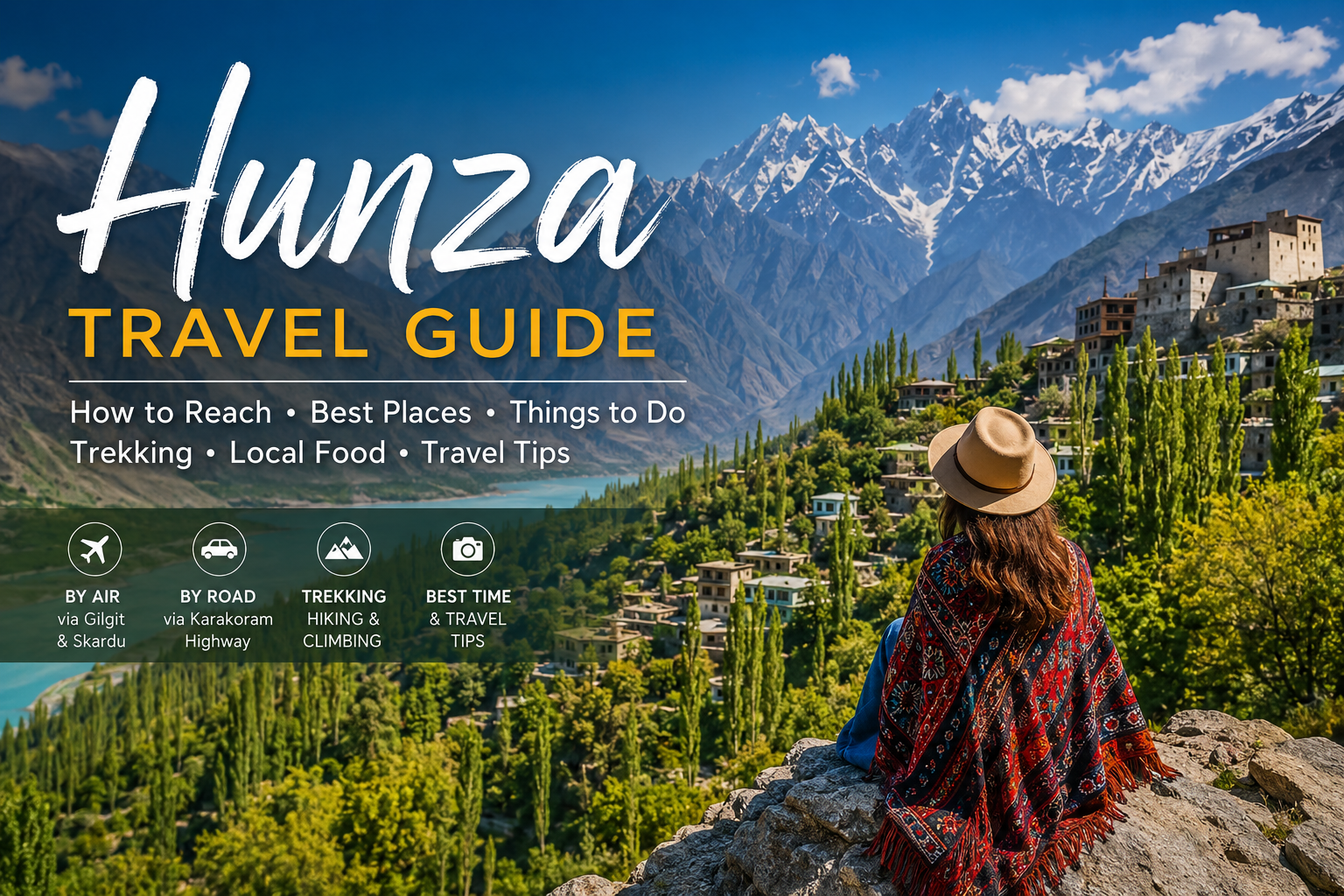
Hunza Valley is one of Pakistan's best destinations
for mountain scenery, heritage, hiking, photography, food and adventure. The
main tourist areas include Aliabad, Karimabad, Altit, Ganish, Gulmit, Passu,
Hussaini and Sost, extending north toward Khunjerab Pass.
Hunza does not have a commercial airport, so visitors
normally either travel overland or fly to Gilgit Airport and continue by road.
Check Out our Hunza
Adventure Tour
Best ways to reach Hunza
There are essentially Six practical combinations:
|
Option |
Route |
|
Fly |
Islamabad → Gilgit → Hunza |
|
Road via KKH |
Islamabad → Abbottabad → Besham → Chilas → Gilgit →
Hunza |
|
Road via Babusar |
Islamabad → Naran → Babusar Pass → Chilas → Gilgit →
Hunza (seasonal) |
|
Fly + Road |
Islamabad → Skardu → Gilgit → Hunza |
|
Mixed Adventure |
Islamabad → Skardu → Deosai → Astore → Gilgit → Hunza |
|
🇨🇳 China Route |
Kashgar → Tashkurgan → Khunjerab Pass → Sost → Passu →
Hunza |
Reaching Hunza via Gilgit Airport || Option 1


Route
Islamabad → Gilgit Airport → Hunza
After arriving at Gilgit Airport, continue by private car,
jeep or van toward Hunza.
Approximate journey
Islamabad → Gilgit: around 1 hour by air, subject to
flight operations and weather.
Gilgit → Karimabad: roughly 2–3 hours by road depending
on traffic, stops and road conditions.
The road follows the Karakoram Highway, making this a
particularly scenic transfer.
Important
Mountain flights are weather-dependent. Fog, cloud,
wind and other conditions can result in delays or cancellations, so don't build
an important international connection immediately after a Gilgit flight.
Best strategy
Keep one flexible day in your itinerary if your
trip depends heavily on a flight.
Travelling to Hunza by road from Islamabad || Option 2


For people who enjoy road trips, this is arguably the best
way to experience northern Pakistan.
Route
Islamabad → Abbottabad → Mansehra → Besham → Dasu → Chilas →
Gilgit → Hunza
The journey follows the Karakoram Highway for much of the
route.
You should treat it as a full-day/overnight mountain
journey, rather than relying on a single exact travel time because weather,
road work, traffic and landslides can significantly affect the journey.
Recommended road itinerary
Day 1: Islamabad → Chilas
Day 2: Chilas → Gilgit → Hunza
This is much more comfortable than attempting to rush the
entire journey.
Why travel by road?
You get to experience:
- Indus River
- Karakoram Highway
- Three Mountain Ranges
region
- Nanga Parbat viewpoints
- Gilgit
- Rakaposhi viewpoints
- mountain villages
- dramatic gorges
- roadside waterfalls
- traditional settlements
🚗 Reach Hunza via Babusar
Pass

A scenic summer road route from Islamabad → Naran →
Babusar Pass → Chilas → Gilgit → Hunza, combining the Kaghan Valley with
the dramatic landscapes of Gilgit-Baltistan. Babusar Pass reaches 4,173 m
and provides a shorter alternative to the KKH route when open.
Route: Islamabad → Naran → Lulusar Lake → Babusar
Pass → Chilas → Gilgit → Hunza
Best for: Scenic road trips, photography and summer
travel.
Note: Babusar is a seasonal route and can close due to snow and
weather.
Reaching Hunza via Skardu Airport || Option 3


Route
Islamabad → Skardu Airport → Gilgit → Hunza
The principal road route from Skardu to Hunza is
approximately 280–300 km, with around 5–7 hours of driving in
favourable conditions.
Travelling to Hunza via Skardu is an excellent option for
travellers who want to combine Skardu and Hunza in one northern
Pakistan adventure.
Islamabad to Skardu by Air
Fly from Islamabad to Skardu Airport. Flights are
subject to airline schedules and mountain weather, so delays or cancellations
are possible. Keep some flexibility in your itinerary.
Skardu to Gilgit by Road
From Skardu Airport, continue by road toward Gilgit.
The journey takes you through spectacular mountain landscapes and river
valleys. If time permits, spend 1–2 days exploring Skardu before continuing.
Gilgit to Hunza by Road
From Gilgit, travel north along the Karakoram
Highway toward Hunza. The route offers dramatic mountain views and access
to scenic stops along the way. Karimabad is a convenient base for exploring
central Hunza.
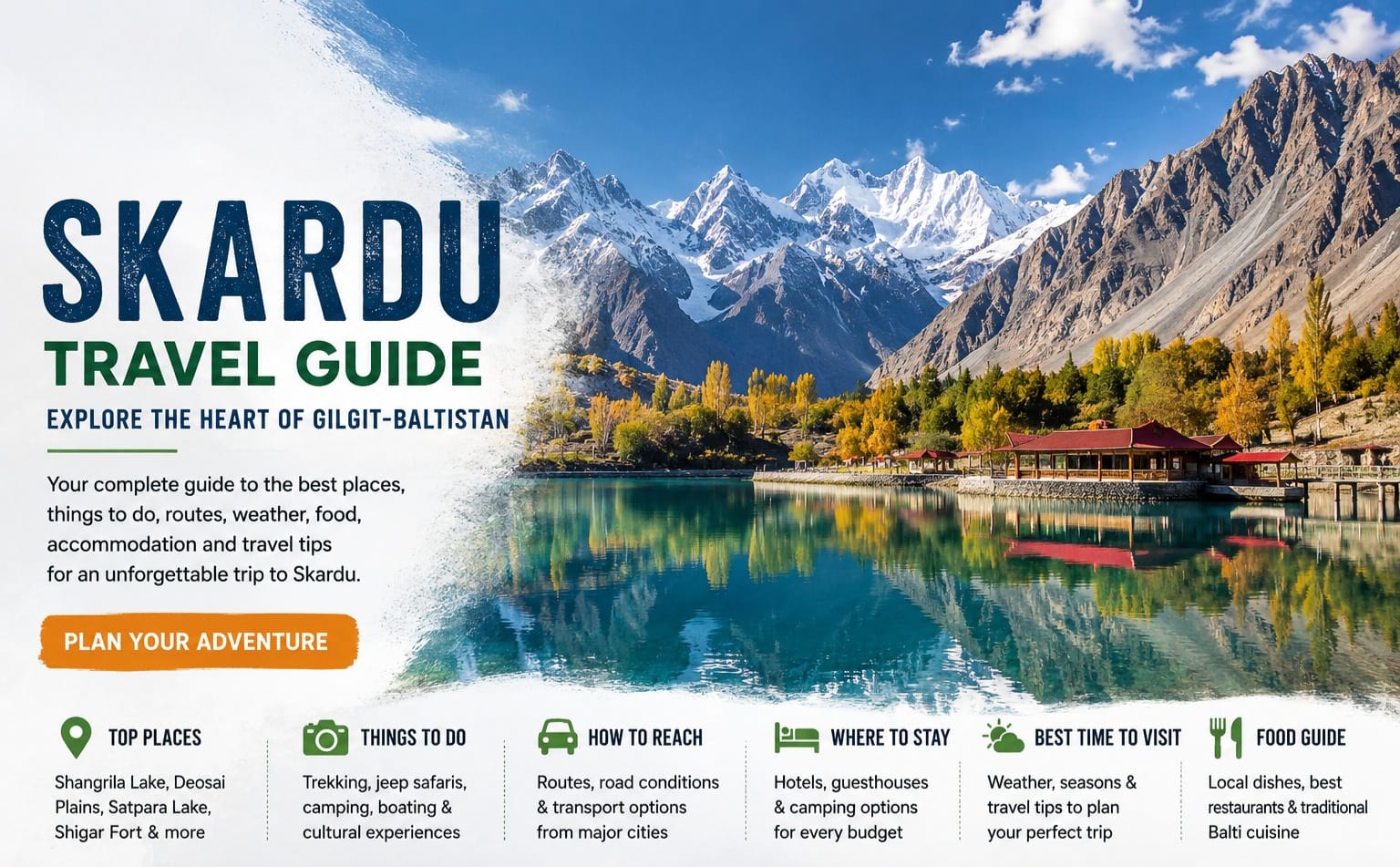
Planning to explore Skardu before Hunza? Read our complete Explore Our Skardu Travel Guide
Check Out our Hunza Adventure Tour
Reaching Hunza Through Deosai – The Ultimate Scenic Route
|| Option 4


Route
Islamabad → Skardu Airport → Deosai → Astore → Gilgit →
Hunza
This route is ideal for travellers looking for an
adventure-focused journey through Skardu, Deosai, Astore, Gilgit and Hunza. It
combines high-altitude plains, remote mountain landscapes and the Karakoram
Highway.
Islamabad → Skardu Airport
Fly from Islamabad to Skardu Airport. Flights are subject to
weather and operational conditions, so keep your itinerary flexible.
Skardu → Deosai
Travel from Skardu to Deosai National Park by 4×4. Deosai is
famous for its vast high-altitude plains, wild landscapes and Sheosar Lake. The
Deosai route is seasonal and is generally accessible during the warmer months.
Explore our Deosai
Plains Camping Adventure
Explore our Deosai Marmots
Tour
Deosai → Astore
Continue across Deosai toward Astore Valley. This section
offers spectacular high-altitude scenery before descending into the greener
Astore Valley.
Astore → Gilgit
From Astore, continue by road toward Gilgit, passing through
dramatic mountain valleys and connecting with the main road network of
Gilgit-Baltistan.
Gilgit → Hunza
From Gilgit, travel north along the Karakoram Highway to
Hunza. Continue toward Aliabad and Karimabad, with opportunities to stop at
scenic viewpoints along the route.
Explore our Hunza Adventure Tour
Explore Our Skardu Travel
Guide
🇨🇳 China Route to
Hunza

Travel from Kashgar → Tashkurgan → Khunjerab Pass → Sost →
Passu → Hunza, following the spectacular China–Pakistan section of the
Karakoram Highway. The journey crosses the dramatic high-altitude landscapes of
Xinjiang before entering Pakistan through Khunjerab Pass at 4,693 metres, then
continues through Upper Hunza to the heart of Hunza Valley.
This route is ideal for travelers looking for a
China–Pakistan overland adventure, combining mountain scenery, high-altitude
passes, traditional settlements and some of the most spectacular sections of
the Karakoram Highway.
Best places to visit in Hunza
Baltit Fort

One of the most recognizable landmarks of Hunza.
Don't just photograph it from outside—walk through the fort
and explore the historic architecture and museum.

A major historical attraction overlooking the Hunza River.
The surrounding Altit village and gardens are
equally worth exploring. Government tourism information identifies Altit and
Baltit among Hunza's major cultural attractions.
Karimabad

The heart of the traditional Hunza tourist experience.
Explore:
- Karimabad Bazaar
- cafés
- handicraft shops
- local food
- traditional houses
- Baltit Fort
- mountain viewpoints
Duikar / Eagle's Nest


One of the best places for:
- sunrise
- sunset
- astrophotography
- panoramic mountain views
You can see multiple major peaks from the viewpoint.

Attabad Lake


One of the most famous attractions in Hunza.
Activities
- boating
- jet skiing
- photography
- lakeside cafés
- kayaking/water activities
where available
The Government of Gilgit-Baltistan specifically lists
Attabad Lake and its water sports among Hunza's major attractions.
Check Out our Hunza
Adventure Tour
Passu Cones


One of the most photographed landscapes in Pakistan.
Spend time around:
- Passu village
- Passu Cones viewpoint
- Passu Glacier area
- Karakoram Highway
Don't simply stop for five minutes and leave. The entire
Passu/Gojal area deserves time.
Hussaini Suspension Bridge
A popular adventure attraction near Hussaini village.
It is known for its exposed mountain setting and views of
the Hunza River.
Safety: follow local instructions and don't overload
the bridge or behave recklessly for photographs.
Gulmit

Gulmit is excellent for experiencing the cultural side of
upper Hunza.
Explore:
- traditional villages
- local crafts
- Gojal culture
- old houses
- mountain landscapes
- nearby viewpoints
Sost – Gateway to Khunjerab Pass & China

Sost is the last major settlement in Pakistan before
Khunjerab Pass, located in Gojal, Upper Hunza, along the historic Karakoram
Highway. At an altitude of around 2,800 metres, it serves as an important stop
for travelers heading toward the Pakistan–China border.
The town is known for its Sost Dry Port, local bazaar,
mountain scenery and cross-border trade with China. Travelers can stop here for
refreshments, local shopping and rest before continuing toward Khunjerab Pass.
Things to Do in Sost
- Visit
Sost Bazaar – Explore local shops, handicrafts, dry fruits and goods from
the China trade route.
- See
Sost Dry Port – Experience one of the key commercial points along the
Karakoram Highway.
- Drive
to Khunjerab Pass – Continue through the spectacular high-altitude
landscape toward the Pakistan–China border.
- Photography
– Capture dramatic Karakoram peaks, mountain roads, valleys and colorful
cargo trucks.
- Explore
Gojal – Use Sost as a base or stopping point for exploring nearby valleys
including Chapursan and Misgar.
- Overnight
Stay – Sost is a practical overnight stop for travelers preparing for the
journey to Khunjerab
12. Khunjerab Pass


At approximately 4,693 m, Khunjerab Pass is the famous
high-altitude Pakistan–China border crossing.
Important
This is a high-altitude excursion, not simply another
Hunza viewpoint.
You should:
- carry warm clothing
- stay hydrated
- avoid overexertion
- allow time for the journey
- check current
access/border requirements before departure
Activities to do in Hunza
🥾 Trekking &
Hiking
Possible activities include:
- Ultar Valley trekking
- Passu-area hikes
- Glacier walks with
appropriate local guidance
- village-to-village walks
- viewpoint hikes
- multi-day trekking in the
surrounding valleys
For serious trekking, use a qualified local guide and check
current route conditions.
Rock climbing & mountaineering
For adventure travelers, Hunza is an excellent base
for rock climbing and mountaineering.
The region includes famous technical peaks such as:
- Lady Finger
- Ultar Sar
- Passu-area peaks
- Batura region mountains
These are serious mountaineering objectives, not
ordinary tourist hikes.
A technical ascent requires appropriate equipment,
experienced climbers, permits where required, weather planning and professional
mountain support.
Cycling
Cycling along suitable sections of the Karakoram Highway can
be fantastic.
Good for:
- photography
- fitness
- village exploration
- slow travel
But don't cycle blindly on busy KKH sections. Traffic and
road conditions require caution.
Photography
Hunza is one of Pakistan's best destinations for photography.
- Rakaposhi
- Ultar Sar
- Lady Finger
- Passu Cones
- Attabad Lake
- Hunza River
- traditional villages
- forts
- orchards
- glaciers
- sunrise/sunset
- night sky
Check Out our Hunza
Adventure Tour
🍽️ Traditional Food in
Hunza
Hunza's cuisine reflects the food traditions of the
Karakoram and Central Asian mountain communities. Local cooking makes extensive
use of wheat, buckwheat, apricots, walnuts, dairy, vegetables and meat. Many
traditional dishes are simple, hearty and well suited to the region's cold
mountain climate.
🥟 1. Chapshuro
A famous Hunza specialty made with thin dough stuffed with
minced meat, onions and herbs, then cooked on a griddle until crisp and golden.


🥟 2. Mamtu
Traditional steamed dumplings filled with minced meat,
onions and spices. Mamtu is one of the most popular foods among visitors to
Hunza.

🫓 3. Gyaling
A traditional thin buckwheat or wheat pancake, usually eaten
with butter, apricot oil, honey or tea. It is particularly popular as a
breakfast dish.

🍞 4. Diram Phitti
A traditional sweetish bread prepared from sprouted wheat
flour. It is often served with butter, apricot oil or local tea.

🍲 5. Harissa
A thick, slow-cooked dish prepared with wheat and meat. It
is a filling traditional meal, especially popular during colder weather.


🍜 6. Dawdo
Dawdo is a traditional noodle soup prepared with handmade
noodles, vegetables and meat or other local ingredients. It is a comforting
dish in the mountain climate.

🍜 7. Giyaling / Fitti
with Local Oil
Different villages and families have their own versions of
traditional flatbreads and pancakes. They are commonly enjoyed with apricot
oil, walnut oil, butter or local honey.

🥣 8. Tumuro Tea
Tumuro is a traditional wild mountain herb used to prepare a
fragrant herbal tea. It is traditionally consumed in Hunza and other parts of
Gilgit-Baltistan.

🍵 9. Butter Tea
Known locally in various forms, butter tea is a traditional
high-altitude drink prepared with tea, salt and butter. It is associated with
the wider Himalayan and Tibetan-influenced food culture of the region.

🍑 10. Hunza Apricots
Apricots are one of the valley's best-known agricultural
products. Visitors can enjoy fresh apricots, dried apricots, apricot jam and
apricot oil.


🌰 11. Walnuts
Walnuts are widely grown and consumed in Hunza. They are
eaten fresh or dried and are also used in traditional foods and local products.


🍯 12. Local Honey
Mountain honey is another local product worth trying. It is
commonly enjoyed with bread, pancakes and breakfast dishes.

🥔 13. Local Potatoes
Potatoes are an important mountain crop and are used in a
variety of home-style Hunza dishes, often cooked with local herbs and spices.

🍒 14. Cherries &
Mulberries
During the appropriate season, Hunza's orchards produce
cherries, mulberries, apricots, apples and other fruits. Fresh seasonal fruit
is widely available in local markets and villages.


Check Out our Hunza Adventure Tour
🌸 Spring in Hunza — April to
May
Best for:
- Blossoms
- Greenery
- Photography
- Pleasant temperatures


☀️ Summer in Hunza — June to August
Best for:
- Trekking
- Hiking
- Road trips
- Khunjerab
- Passu
- Water activities


🍂 Autumn in Hunza — September
to October
One of my favourite periods for Hunza.
You get:
- Autumn colours
- Crisp weather
- Excellent photography
- Fewer crowds than peak
summer


Check Out our Hunza
Adventure Tour
❄️ Winter in Hunza — November to
March
Beautiful but considerably more demanding.
Expect:
- Cold weather
- Snow
- Possible road
disruptions
- Reduced tourist services
- Difficult access to some
attractions


Things you SHOULD do
✅ Respect local culture
Hunza is culturally rich and relatively conservative in many
communities.
Dress appropriately, particularly when visiting villages and
religious/cultural sites.
✅ Ask before photographing
people
Especially:
- women
- children
- private homes
- cultural events
✅ Carry cash
Don't assume every small business accepts cards or has
reliable internet.
✅ Keep your ID/passport
The official GB tourism guidance recommends carrying your
national ID/passport while travelling.
✅ Buy local products
Purchase:
- handicrafts
- dried fruits
- jams
- local products
This directly supports local businesses and communities.
✅ Check Road conditions
before leaving
Mountain roads can change quickly because of:
- landslides
- Rockfall
- Rain
- Snowfall
- Road maintenance
Check Out our Hunza
Adventure Tour
✅ Keep your itinerary
flexible
This is especially important when flying to Gilgit or
Skardu.
Things you SHOULD NOT do
❌ Don't treat mountain roads like motorways
❌ Don't litter
❌ Don't climb restricted or dangerous areas
❌ Don't disrespect local
traditions
❌ Don't depend entirely on mobile internet
A perfect 7-day Hunza itinerary
Day 1 — Gilgit → Hunza
- Arrive Gilgit
- Drive to Hunza
- Rakaposhi viewpoint
- Check into hotel
- Karimabad evening
Day 2 — Karimabad
- Baltit Fort
- Karimabad Bazaar
- traditional Hunza food
- Altit village
- Altit Fort
- sunset at Duikar
Day 3 — Attabad & Gulmit
- Attabad Lake
- boating/water activity
- Gulmit
- local village
exploration
- Hussaini Bridge
- Passu
Day 4 — Passu
- Passu Cones
- Passu village
- glacier viewpoints
- photography
- local lunch
- return/overnight in Passu
or Hunza
Day 5 — Khunjerab
- Sost
- Khunjerab National
Park/Pass
- Pakistan–China border
area
- return to Hunza
Day 6 — Adventure Day
Choose one:
Option A: Ultar Valley hike
Option B: Rock climbing
Option C: Photography tour
Option D: Cycling
Option E: Village and cultural tour
Day 7 — Hunza → Gilgit → Islamabad
Drive back to Gilgit and fly, subject to flight
availability.
Better: Keep an additional buffer day if your Islamabad
flight is important.
Check Out our Hunza
Adventure Tour
Best overall route for an adventure traveler
If you want to experience both Skardu and Hunza, I'd
recommend:
Islamabad → ✈️ Skardu→ Deosai/Astore →
Gilgit Gilgit → Hunza → Gilgit → ✈️ Islamabad
This gives you:
Skardu + Deosai + Astore + Gilgit + Hunza + KKH + Khunjerab
It's considerably more interesting than simply flying
Islamabad → Gilgit → Hunza → Islamabad.
For a normal family trip, however, I'd keep it simpler:
Islamabad → ✈️ Gilgit → Hunza → 🚗 Gilgit
→ Islamabad
That minimizes unnecessary transfers while still giving you
plenty of time in Hunza.